A single can leaving your facility with a compromised seam can have serious consequences. The average direct cost of a food recall is $10 million, and that number doesn't begin to cover the damage to your brand. For food and beverage producers, a metal can’s double seam—so-called because it requires two precision operations to form the seam is the most critical failure point on the line. Keeping it within spec is the most reliable way to protect your product, your customers, and your bottom line.
The safety of canned products is sealed into each can by the airtight double seam that creates an hermetic seal. The double seam is a metal-to-metal joint formed by interlocking 5 layers of metal, two from the can body and 3 from the end. The layers are then compressed and ironed tightly together, forming the airtight seal.
During this operation, voids are formed, not all of which can be ironed out. These are filled with seaming compound. Like the seam formation, this is another precision process, requiring accuracy in location, thickness, and tightness of the compound.
The Double Seam is a Dual Process of Many Steps
The first operation seaming roll rolls the end material under the can flange, interlocking the can and end. In this operation wrinkles are created in the end material due to the reduction in the diameter of the material.
The second operation seaming roll has a flatter profile that is used to iron out the wrinkles in the material, created in the first operation. The second operation is critical for creating a seam with the proper tightness, so that leaking is prevented.
Both stages are vital to the success of the operation. Ninety percent of the seam structure is formed during the first operation. If the adjustments for the double seam aren’t accurate, or the rolls are worn, the seam will not be the hermetic seal you require. See the operation here in this animation, Angelus Can Seamers: A Primer on the Formation of the Double Seam.
Critical Measurements are Keys to Your Seam Security
Preventing seam failures isn't complicated, but it does require discipline. It comes down to monitoring seven specific measurements and understanding how they relate to each other. Get those numbers right and keep them in spec, and you've removed the most significant source of packaging risk from your operation. The specifications are typically set by the can manufacturer, or by your company’s Quality Control team. Taking and recording the measurements so they can be tracked is a simple but critical step toward the success of your seaming operation.
1. Seam Thickness
Seam thickness is the overall width of the double seam. It's an indicator of seam tightness and the pressure applied during the seaming operation. A reading that's too thick or too thin signals a problem with the seaming rolls or chuck that needs immediate attention.
The amount of compression applied in the 2nd phase of the seaming operation is what gives you the thickness. This calculation will give you a good approximation of seam thickness.
3 x Cover Thickness
+ 2 x Body Thickness
+ .005” (.13mm) allowance for sealing compound
= Correct Seam Thickness
On its own, seam thickness doesn't tell the full story. Think of it as a warning light: it tells you something is off, but you need the other measurements to understand what's actually wrong and where. When the thickness is out of spec, treat it as the starting point for a deeper investigation.
2. Height
Seam Height
Also called seam length, seam height is the measurement of the seam from top to bottom. It is directly influenced by the geometry and interlocking of the cover and the body hooks. It plays a central role in calculating the most important measurement of all: double seam overlap.
Consistent seam height is required for a reliable hermetic seal. When it varies, that instability leads to inconsistent overlap, and inconsistent overlap is how seals fail. It's a downstream effect that starts with how your tooling is set up and maintained.
Pin Gauge Height
Pin Gauge Height is the distance between the bottom of the seaming chuck flange and the top of the lower lifter plate. This is a factor in setting up the machine properly, rather than a quality control check after the seam is created. The Pin gauge Height setting assures lifter deflection, which is critical in creating enough force to bend the can flange down and create the body hook. If a change is made to the container or tooling, the Pin Gauge Height needs to be verified.
3. Countersink Depth
Countersink depth is the distance between the top radius of the double seam to the bottom of the countersink radius, adjacent to the chuck radius. This is one of the critical external seam control components, along with seam thickness and height.
4. Body Hook
The body hook is the portion of the can body flange that is bent down and tucked inside the double seam. Its length and condition are direct inputs to the double seam overlap calculation. A body hook that is too short, too long, or shows signs of wrinkling or cracking is a red flag that something in the seaming process needs attention.
Short body hook can be caused by many issues. Most commonly, however, it is the result of the pin height being too high, the spring pressure being too low.
Conversely, long body hook is most commonly caused by the pin height being too low, or the spring pressure being too high.
5. Cover Hook
The cover hook is the portion of the can end rolled into the seam. Like the body hook, it must be free of defects and formed to the precise length required to create the required overlap within the seam.
The relationship between the body hook and the cover hook determines the final overlap, so both must be correctly formed. The cover hook takes shape during the first operation of the seaming process. Short cover hooks can be caused by numerous issues, but are most commonly caused by a loose setting of the first operation roll to the seaming chuck. Conversely, a long cover hook is most commonly caused by a tight setting of the first operation roll to the seaming chuck.
6. The Cornerstone: Double Seam Overlap
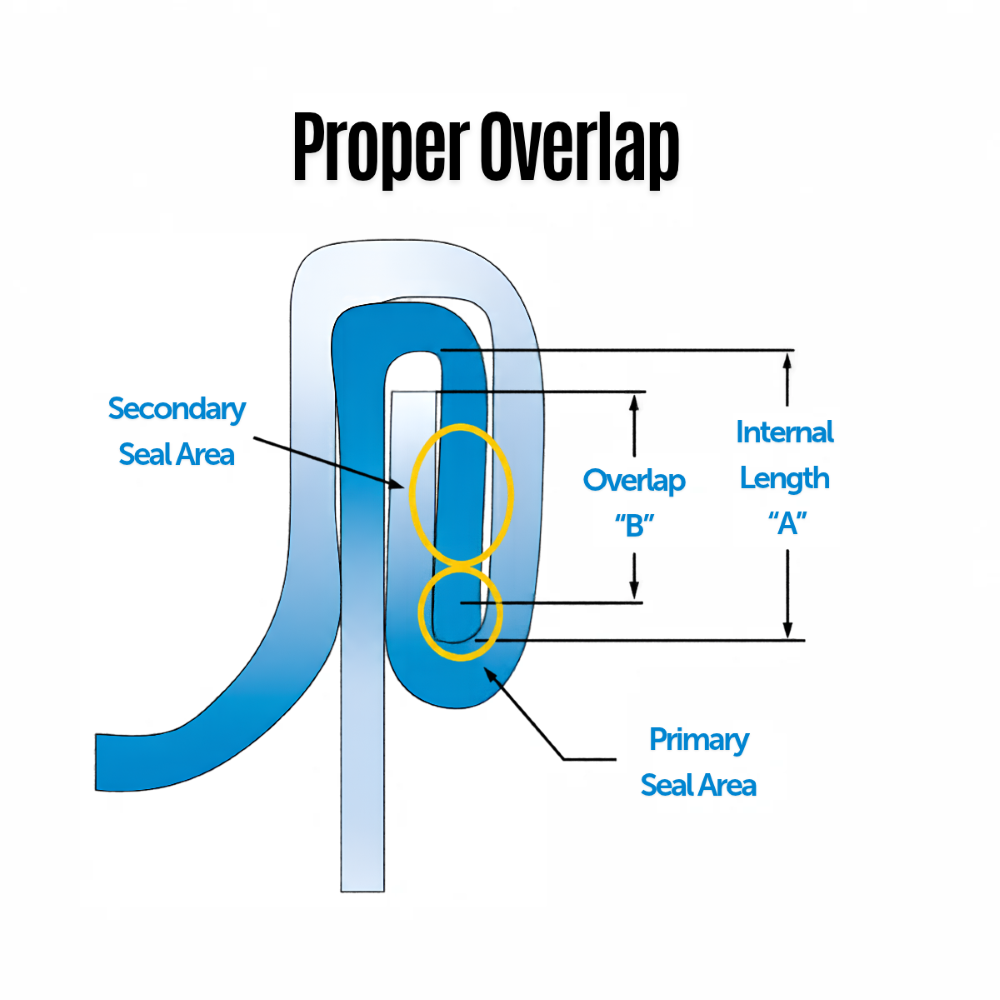
The Double Seam Overlap is where the cover hook and the body hook actually form the seal, and is the heart of the double seam operation. The primary seal is formed when the body hook butts into the sealing compound in the curl at the end of the cover hook radius. The secondary seal is where cover hook and body hook overlap.
It's the physical distance that the body hook and the cover hook are engaged within the seam, the point where they interlock to prevent leaks and contamination. The greater the overlap within specification, the more secure the seal. Without sufficient overlap, a hermetic seal is not possible.
The Double Seam Overlap Calculation Explained 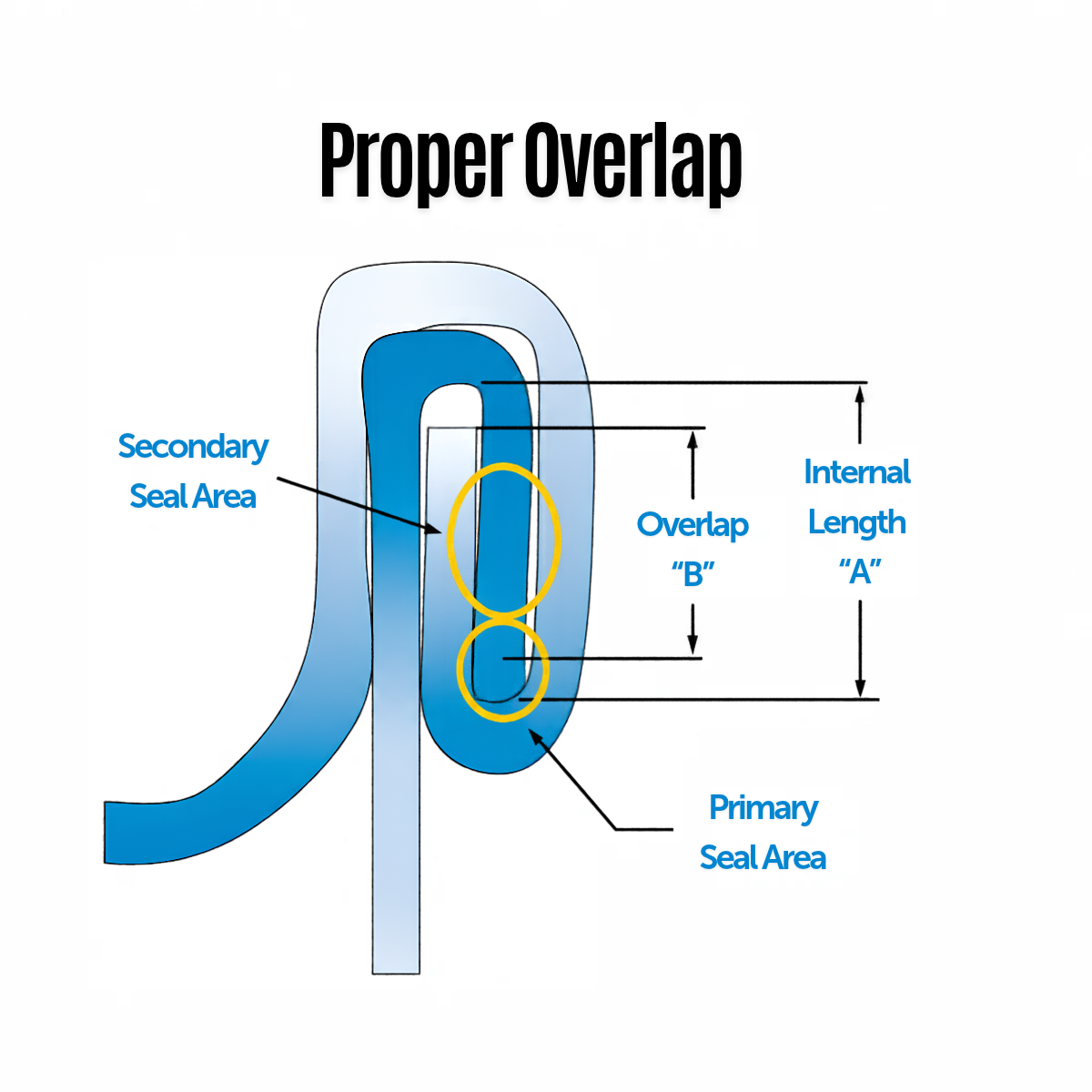
A proper overlap is either measured by a specific number as determined by the can manufacturer or is a percentage of seam overlap. The percentage is the length of the Overlap "B" in relation to the internal length of seam "A" multiplied by 100. This is calculated as:
B/A x 100 = percentage overlap
Many seam evaluators use 55% as a minimum overlap percentage.
The industry-standard formula is:
Overlap = (Body Hook + Cover Hook + End Thickness) - Seam Height
Each component must be precisely measured from a seam teardown:
- Body hook: the portion of the can body flange bent down into the seam
- Cover hook: the portion of the can end rolled into the seam
- End thickness: the gauge of the lid material itself
- Seam height: the vertical measurement of the completed seam
The resulting overlap is typically expressed as both an absolute value and a percentage. Industry standards generally require overlap percentages between 40 and 60 percent, though specific requirements vary by can type, product, and regulatory body.
Common Causes of Poor Overlap
Worn or improperly adjusted tooling is the most common root cause. Seaming chucks and rolls that have degraded will fail to form hooks properly, resulting in weak, unreliable seals. This is why a proactive maintenance schedule matters. Even the most sophisticated seaming equipment cannot compensate for worn components.
Incorrect seamer setup is another frequent problem. When lifter pressure is too high or too low, or when the first and second operation rolls are improperly positioned, the hooks won't form to the required dimensions. Following manufacturer specifications precisely and thoroughly training operators in proper adjustment procedures are the most effective countermeasures.
At BW Packaging, our Angelus Seamers are engineered for the kind of precision that consistently produces reliable overlap. The best-in-class tooling design ensures body and cover hooks are formed to spec at every speed, so quality doesn't suffer as production scales up.
7. Seam Gap
Seam gap is the internal dimension between the outer radius of the body hook and the inner radius of the cover hook. If the 1st operation is a success, and has the proper seam thickness, pin height, lower lifter spring pressure, roll-to-chuck vertical relationship, and roll-groove profile, the seam gap should not exceed .003” (.076mm). The seam gap is important to check for, but with Angelus seamers, seam gap should not occur.
Measurement Tools
The precision tools needed for can seaming measurements are specialty instruments. Measurements should be recorded on a seam evaluation sheet to maintain a record of the can seam. Essential tools include:
- Double Seam Micrometer (measures seam thickness, height, body hook and cover hook)
- Countersink Gauge (measures the distance from the top of the seam to lowest point in the countersink countersink)
- Sanitary or Bacteriological Can Opener (removes a portion of the cover for seam strip tear down)
- Motorized Can Seam Stripper (separates cover and seam hooks; necessary for evaluating seams on 2-piece aluminum cans)
- Nippers or End Cut Pliers (for tearing down the double seam for internal inspection)
- Power driven seam saw (to cut a cross section through the double seam for internal inspection)
- 12” Mill Smooth File (a critical tool for filing through 1st operation steps to analyze wrinkling)
- Optical Can Seamer Projector (Enlarges seam cross section so viewing and taking internal measurements is possible)
- Computerized Seam Analysis Workstation (Used for all internal and external seam measurements, this enlarges and analyzes can seam cross-sections)
From Measurement to Mastery
A solid seam inspection program is about more than collecting data. It's about reading what that data is telling you. Each of these seven measurements provides part of the picture, but the double seam overlap calculation is the verdict on whether the seal will hold.
Here is a practical quality assurance routine to implement on your line:
- Run visual checks on seam appearance every 30 minutes during production, selecting a can from each seaming station.
- During the visual inspection, feel for defects such as sharp edges, metal fracture, or scuffing.
- Conduct a full seam-teardown analysis at least every 4 hours on a can from each seaming station. Measure all 7 elements and compare them against specifications.
- Log all measurements over time to track trends and catch negative drift before it becomes a defect.
- Investigate and correct any out-of-spec readings immediately, tracing them back to tooling condition, machine setup, or material quality.
- If any specification is suspect for any reason, before making any adjustments, re-inspect the first operation.
- Schedule preventive maintenance based on manufacturer recommendations to keep tooling within dimensional tolerances before wear becomes a problem.
When you consider that unplanned downtime can cost food and beverage manufacturers hundreds of thousands of dollars per hour, and that the FDA's regulations under 21 CFR 113 mandate specific seam evaluation procedures, the investment in a rigorous inspection program becomes straightforward.
Key Takeaways
- Overlap Is Paramount: Double-seam overlap, calculated as (Body Hook + Cover Hook + End Thickness) - Seam Height, is the single most critical measurement for ensuring a hermetic seal. It represents the physical interlock that prevents leakage and contamination.
- It's a System of 7: Seam integrity can't be determined by a single measurement. Seam thickness, height, body hook, and cover hook, overlap and gap are all inputs that collectively determine the quality of the final overlap.
- Tooling Is the Root Cause: The most common cause of poor overlap is worn or incorrectly adjusted seamer tooling, particularly seaming chucks and rolls. Proactive maintenance is the most reliable defense.
- Formula for Success: The double seam overlap calculation, (Body Hook + Cover Hook + End Thickness) - Seam Height, is a formula every plant and quality manager needs to know and apply consistently, with industry standards typically requiring overlap percentages between 40 and 60 percent, with 55% as a minimum acceptable standard.
- Prevention Beats Reaction: The cost of a single recall, averages millions of dollars in direct costs alone, far outweighing the investment in proper seam inspection equipment and procedures. When combined with unplanned downtime costs of hundreds of thousands of dollars per hour, the business case for rigorous seam measurement is clear.
BW Packaging is a Reliable Partner for Your Precision Seaming Operation
BW Packaging has led seaming technology for over 100 years, offering a full line of high-performance machines designed to meet the critical needs of food and beverage processors. We have robust, innovative solutions that will suit your product and speed requirements. Our passion for seaming technology drives us to lead with innovative designs such as our Angelus V-Series, that delivers best-in-class seam integrity, hygienic design, fast and reliable changeover, many interchangeable parts to help control your inventory, and superior lightweight can handling.
We also provide comprehensive support services, including OEM parts, expert Field Service to resolve any problem quickly, and our Seamer University training programs, conducted at our locations or yours. With our innovative engineering solutions and full-service support, you’ll find our dedication to helping you get the most from your seamer investment is unmatched.
For more information about how our precision seamers can enhance your production line, contact us.
Source: Pocket Guide to Evaluating Double Seams, 2nd edition, BW Packaging