Reports of contaminated foods, associated recalls, and impacts on manufacturers and their customers are in the news regularly. Globally, 866 million people are sickened each year by contaminated food, according to the World Health Organization. According to the Center for Disease Control (CDC), produce accounts for nearly 50% of outbreaks. For food manufacturers, direct recall costs, such as product retrieval, reimbursement and fines, start at millions of dollars per event. That does not include the costs of the interruption to the manufacturer’s business, lost revenue from cancelled or delayed contracts, insurance increases, which can be an additional hit of 3–5 times as much. The cost to your brand reputation is incalculable.
While what happens in the fields and on the way to your plant is difficult to control, you can make sure your production line follows current Good Manufacturing Practices (cGMPs) with the right approach. The manufacturer of your packaging equipment can be a valuable ally in helping you ensure your production line is sanitary.
Strategic equipment choices, innovative design features and a strong Original Equipment Manufacturer (OEM) partner can help lower your risk.
Problem Areas for Product Contamination—What to Watch For
Temperature Control
Maintaining produce and other food products at the proper temperature is the first step in preventing bacterial growth. Temperature controlled transportation and storage makes this easy to accomplish.
Production Environment
The area around your production line, both above and below, should be inspected for problems such as leaky pipes and backed up floor drains. Even when functioning properly, these areas, along with air compressors, need to be monitored as places where excessive moisture, including condensation, can create a welcoming environment for bacteria.
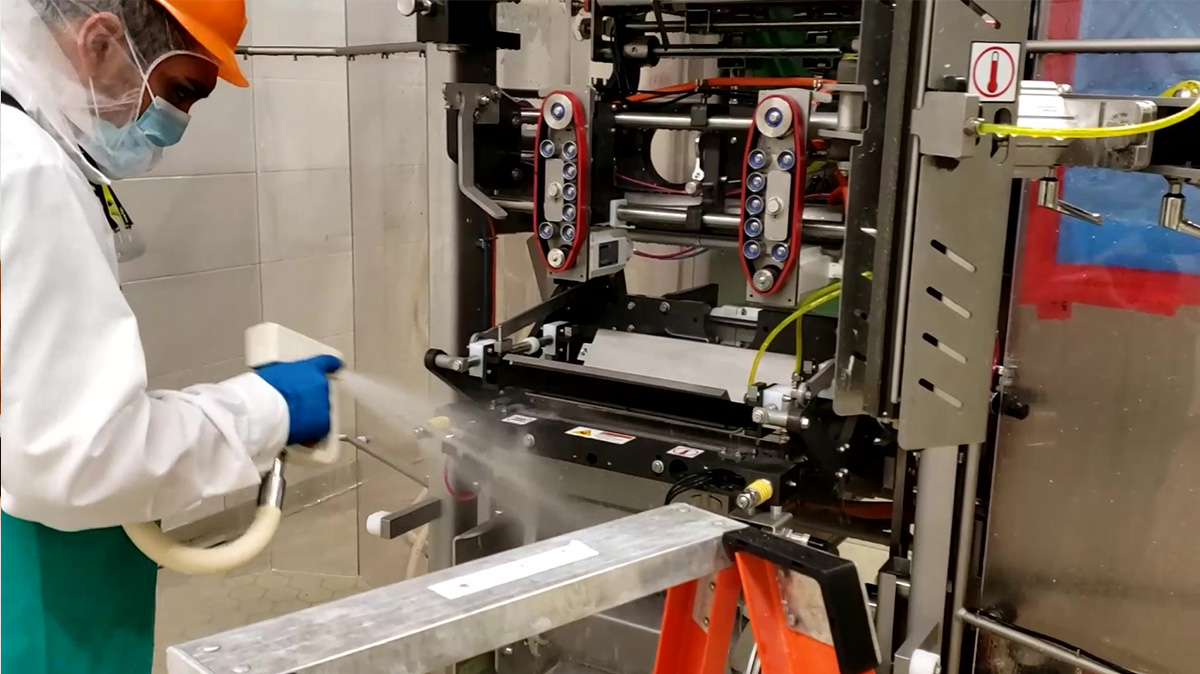
Despite needing to control moisture in the production area, one of the most important things you can do to prevent contamination is maintain and document a robust cleaning schedule. Follow the OEM’s recommended cleaning procedures and frequency, adding to it as needed by any regulatory agency guidelines with which you need to comply. Be sure to keep a record of the schedule and process for inspection purposes.
Within your production line, the only place product is actually touching the machine is in the forming tub. Gas flushing here removes oxygen, replacing it with gases such as nitrogen or carbon dioxide. In addition to stopping the growth of bacteria, the gas helps preserve product freshness, while also creating a pillow that protects against crushing. If you aren’t currently using a gas flush system, it can be added to an existing packaging line. Your OEM should be able to suggest which gas is the best for the products you package.
Transition Points
Places where packaging materials or products are transferred between processes can also be places of risk. These can include loading film rolls, catch pans where product can accumulate, and moving packaged goods to sealing stations. Watch for places with multiple risk factors: human interaction with product, places where product residue can accumulate, and complex equipment.
Equipment Design Features that Support Your Sanitation/Hygiene Goals
In addition to taking advantage of gas flush technology, there are other ways the design of your packaging equipment contributes to how hygienic your product line is.
Hygienic Design Principles
The guidelines below ensure that machines are engineered and built to be free of cracks and crevices where bacteria, debris and moisture can gather. Important features of Hygienic Design are:
- Using continuous welds instead of spot welds
- Sloped surfaces so water runs off
- Changing from tubular frames to flat frames to prevent moisture from getting inside the frame
- The use of standoffs to keep bearings and drives, where debris can be caught, out of product zones
- Machine accessibility—your operators and maintenance team should have easy access to every part of the machine to do the thorough cleaning required to prevent the growth of bacteria
Some OEMs work to achieve special certifications for the markets they serve. For example, BW Packaging proudly maintains 3-A certification, earned through a rigorous authorization and inspection process. The USDA also provides certification, and BW Packaging’s Hayssen ISB (Intelligent Sanitary Bagger) has received USDA Dairy Acceptance, as well as USDA Meat and Poultry Acceptance.
How to Choose the Right Materials in Your Packaging Equipment
Translating a sanitary design into a hygienic machine begins with the materials used. Be sure your OEM partner uses not just stainless steel, but a food-grade stainless steel (304 or 316) on your packaging machinery. Food grade stainless steel will stand up to harsh chemicals, brine, acidic products such as tomatoes or citrus, and provide better resistance to corrosion and pitting.
Although less expensive steel can be used, the reduction in the ability to maintain the hygiene of your production line, the lower lifespan of the equipment under harsh conditions, and the long-lasting harm to your brand can make this choice more expensive in the long run. Most importantly, food grade stainless steel is fundamental to having an effective Clean-in-Place (CIP) procedure.
Advantages of Clean-in-Place Systems
The sanitation of your product line can be transformed by a CIP system. CIP delivers precise cleaning solutions to every equipment surface, reaching areas that manual cleaning might miss.
However, it’s a rigorous process, which is why food grade stainless steel is so important. Your machine must be able to withstand the strong cleaning products and high temperatures of a CIP procedure on a regular basis.
Look for an OEM Who Plans for Your Sanitation Success
An example of how design and material can come together to meet the most exacting sanitary needs is BW Packaging’s Hayssen ISB. Packaging everything from frozen meal kits to pre-sliced apples, the ISB is engineered for wet production environments, yet still meets the highest hygienic and food safety standards. Its sanitary design withstands IP66 wash down can help reduce cross-contamination risks, ensuring product integrity throughout your operation.
BW Packaging’s engineers didn’t overlook the demands of real-world production in their design, though. The ISB provides speed, accuracy and reliable high-integrity seals. In addition, with the award-winning OpView™ HMI, your operators can quickly set up, run, troubleshoot and even changeover the line to meet your production objectives. Step-by-step instructions enable your operators to maximize machine speed and productivity.
Investing in packaging equipment that is engineered to help you prevent food borne illness and cross contamination is far more cost effective than dealing with the ramifications of an outbreak at your production facility. Through engineering and innovation, your OEM partner will be able to help you avoid the sanitation problems faced by others in the market.
Ready to enhance your facility’s bacterial contamination strategy? BW Packaging is happy to review your current operation and explore hygienically designed packaging solutions that will meet your needs and keep you out of the headlines. Contact Us today.