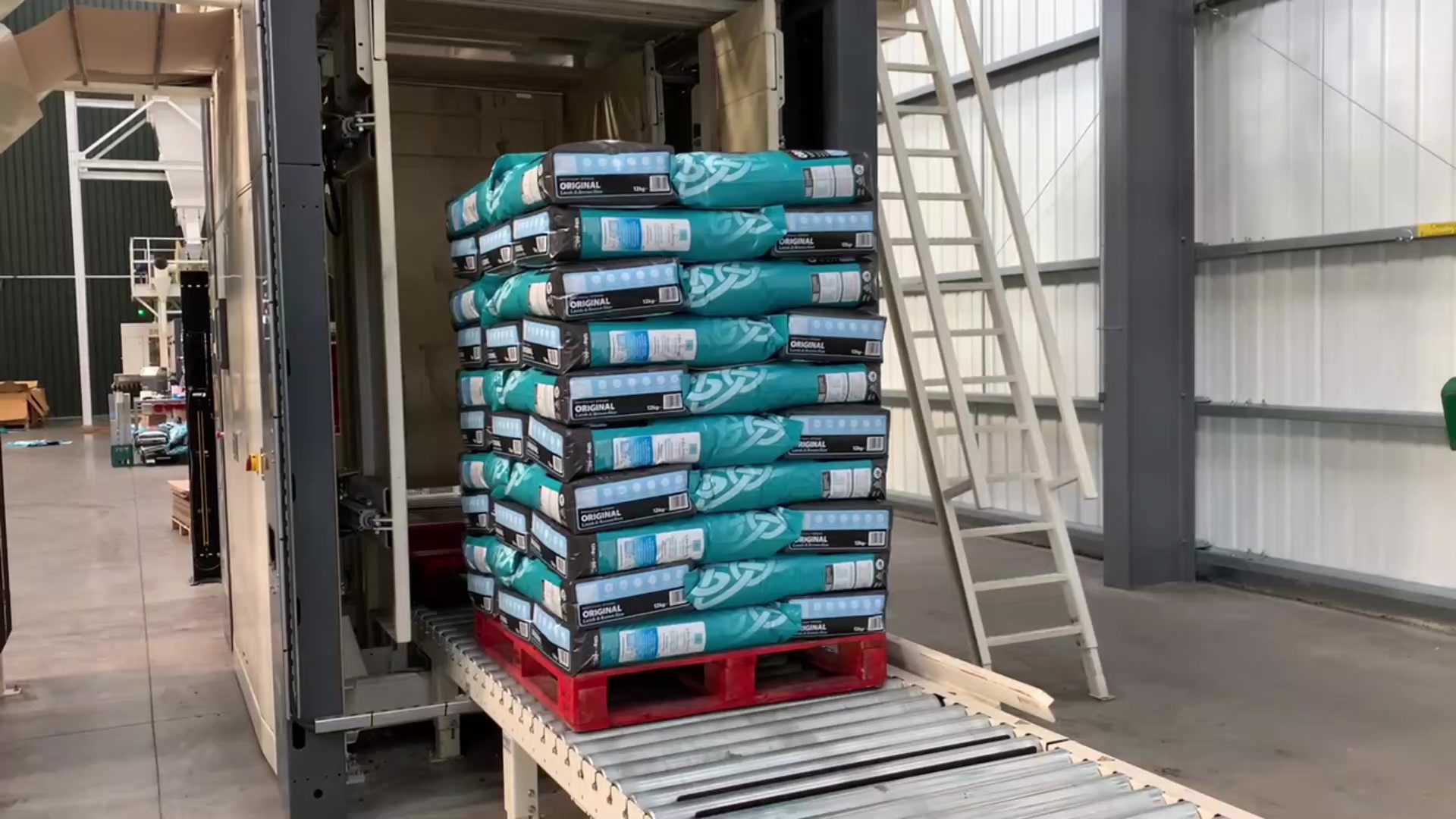
A palletizer misses its pattern by half an inch, a bagger drifts out of tolerance, and a high-margin SKU starts backing up downstream. In pet food packaging, small inefficiencies rarely stay small for long.
Pet food producers are operating under a different set of constraints than they were even five years ago. SKU proliferation is accelerating as brands expand into premium, functional, and breed-specific formulations. At the same time, production runs are getting shorter while format variability increases.
Industry reporting from PMMI points to continued investment in automation, workforce constraints, and the need for more flexible packaging systems. As product portfolios expand a higher product mix and more frequent changeovers are needed. For packaging operations, that shift changes the objective. It’s no longer about peak throughput alone, it’s about sustaining efficiency across constant variation.
Layer in persistent labor shortages, tighter retailer expectations around pallet quality, and rising maintenance costs, and the pressure concentrates at the end of the line. Bagging and palletizing systems are now expected to handle a much broader operational envelope.
That mismatch is where most bottlenecks begin.
What Modernization Means in a Pet Food Environment
Modernizing a pet food packaging line is less about replacing old machines and more about aligning equipment capability with current production reality. Bagging and palletizing systems now need to handle multiple product densities, a wider range of bag materials, and faster transitions between SKUs—often within the same shift.
Pet food introduces specific challenges. Dense kibble behaves differently at fill than lightweight or irregular treats. Packaging formats range from multiwall paper bags to polywoven and emerging recyclable films. Each combination affects how product meters, how bags settle, and how reliably they can be stacked.
Modern systems address these variables through tighter process control. Servo-driven bagging platforms maintain consistent fill accuracy across product types while automatically correcting variations. Palletizers with programmable pattern control place bags with repeatable precision, improving stack stability across formats.
The result is less operator intervention, fewer minor stops, and more predictable line performance. These are all key contributors to overall equipment effectiveness (OEE).
Warning Signs Your Pet Food Packaging Line Is Falling Behind
In most cases, obsolescence doesn’t arrive all at once. It shows up as small, persistent issues that gradually limit performance:
Inconsistent pallet quality
Misaligned or unstable stacks create problems beyond the packaging line. They affect warehouse handling, transportation, and ultimately retailer acceptance. When pallet integrity becomes unpredictable, it often traces back to older palletizing technology that lacks precise bag control.
Throughput bottlenecks at the bagger
If upstream production is outpacing packaging, or if lines are routinely extended to meet demand, the bagging system is a likely constraint. Older systems may struggle to maintain speed while delivering consistent weights, especially across multiple formats.
Escalating maintenance and unplanned downtime
Wear parts, legacy controls, and limited parts availability can turn routine maintenance into a recurring disruption. Over time, the cost of keeping older equipment running begins to rival replacement investment.
Operator dependency and training challenges
Systems that rely heavily on manual adjustment or tribal knowledge introduce variability. In a labor-tight environment, long training curves and ergonomically taxing tasks make retention more difficult.
Limited flexibility for SKU expansion
New product launches often bring new bag sizes, materials, or pallet configurations. Equipment that cannot adapt without significant mechanical modification becomes a barrier to growth.
Where Modernization Delivers Immediate Impact
Precision Palletizing and Stack Integrity
Modern palletizing systems have moved away from mechanisms that rely on pushing, dropping, or clamping bags into position. Instead, they use controlled handling approaches that center and place each bag individually.
This matters in pet food, where bag consistency can vary depending on product density and material type. By guiding each bag into position and releasing it precisely at the programmed coordinates, these systems reduce stack variation and improve pallet stability. The result is fewer damaged bags, cleaner unit loads, and smoother downstream logistics.
High-Speed, Multi-Format Bag Filling
Bagging performance is often where capacity gains are realized—or lost.
In pet food applications, mid- to large-format systems typically operate in the 15 to 40 bags-per-minute range, depending on fill weight, product density, and material type. Maintaining that level of throughput while holding tight fill tolerances is where modern systems separate from legacy equipment.
Servo-controlled dosing continuously adjusts to product variation, reducing the need for manual correction. The system can sustain output without sacrificing accuracy, even as materials or product characteristics shift.
Compatibility also matters. Current platforms are designed to run:
- Multiwall paper
- Poly and polywoven bags
- Emerging recyclable or lightweight film structures
That flexibility allows plants to adapt packaging formats without reengineering the line.
Flexibility Without Complexity
Consider a regional pet food manufacturer running a mix of dry kibble SKUs across multiple bag formats. Their legacy line met baseline demand but required frequent intervention at both the bagger and palletizer. Stack inconsistency created downstream handling issues, and changeovers extended planned downtime.
After upgrading to a modern bagging and palletizing configuration, the plant saw a measurable shift in line stability. Unplanned downtime—previously a routine part of daily operation—dropped to occasional events, and operator intervention during runs decreased significantly.
Internally, the team attributed gains in OEE primarily to improved availability and fewer minor stops. Changeovers that once required extensive manual adjustment became faster and more repeatable. The outcome wasn’t just higher throughput—it was a line that performed consistently across shifts.
Operator Enablement and System Reliability
Training time has become a critical constraint. Equipment that requires extensive manual calibration or deep institutional knowledge limits workforce flexibility.
Updated interfaces, standardized controls, and integrated diagnostics help simplify operation. Combined with structured training programs and ongoing support, these systems reduce ramp-up time and improve consistency across shifts.
How This Plays Out on the Plant Floor
Consider a regional pet food manufacturer running a mix of dry kibble SKUs across multiple bag formats. Their legacy line met baseline demand but required frequent intervention at both the bagger and palletizer. Stack variability led to rework in the warehouse, and changeovers between formats extended downtime.
After upgrading to a modern bagging and palletizing configuration, the plant saw improvements in three key areas: more consistent pallet quality, reduced manual adjustments during production runs, and shorter changeover intervals between SKUs. The net effect wasn’t just higher throughput—it was a more predictable, stable operation.
What Comes Next for Pet Food Packaging
Pet food packaging lines are moving toward greater autonomy. Integration with plant-level systems—MES (Manufacturing Execution Systems) and ERP platforms—will allow for real-time performance monitoring, predictive maintenance, and dynamic production scheduling.
At the same time, sustainability targets will push equipment to handle a broader range of recyclable and lightweight materials without sacrificing speed or accuracy.
Plants that modernize now aren’t just solving today’s bottlenecks. They’re building the foundation for packaging operations that can adapt as quickly as the pet food market itself.