Devices to reveal whether something has been tampered with have been around since the ancient Romans used hot wax to seal documents and letters. They were not important to commercial packaging until 1982 when Tylenol tainted with potassium cyanide was planted on store shelves, and seven people were killed. As a result, the Food and Drug Administration (FDA) created regulations for tamper-evident and tamper-resistant packaging. Packaging equipment manufacturers understood the need to protect their customers, and end consumers in changing times and developed the technologies needed to automate the application.
It's important to understand that tamper-evident packaging does not prevent tampering. Instead, it provides a visible indication that a package has been opened, altered, or compromised after production. The right solution can help manufacturers demonstrate their commitment to safety while balancing branding, sustainability, production efficiency, and cost.
Today, consumer expectations extend well beyond pharmaceuticals. Food, beverage, personal care, electronics, pet products, household products, and industrial goods increasingly rely on tamper-evident packaging to provide confidence that products reach customers exactly as intended.
So how do you decide which tamper-evident solution is right for your product?
The three most common options are wafer seals, shrink bands, and shrink sleeves. Each offers unique advantages depending on your packaging format, production requirements, and brand objectives.
Wafer Seals
What Are Wafer Seals?
Wafer Seals are small, round, rectangular, or other shaped adhesive tabs that are applied across carton flaps and other package openings. Typically made from PET, clear polystyrene, or tough synthetic paper, wafer seals have a permanent adhesive backing, enabling them to bond with cardboard, paper and plastic packaging.
They are affixed across carton flaps or other secondary packaging to seal the package.
These seals can be produced in a variety of shapes and sizes and may include security features such as destructible materials, perforations, or hidden "VOID" messaging that appears when removal is attempted.
When Should You Use Wafer Seals?
Wafer seals are often a strong choice when:
- The product is packaged in a carton or folding box
- Need tamper evidence without changing primary package appearance
- Looking for the lowest material consumption option to achieve sustainability goals
- Existing carton graphics already do most of the merchandising work
Common applications include pharmaceuticals, medical devices, cosmetics and specialty consumer products.
When Are Wafer Seals Not the Best Choice?
Wafer seals may not be ideal when:
- The product requires tamper evidence directly on the bottle or container The package design emphasizes premium visual appeal
- High-moisture or contaminated environments may impact adhesion
There is limited space for the larger wafer sealing equipment
What Solutions Does BW Packaging Offer?
Harland’s Top and Bottom Pressure Sensitive Labelers (the TBL 200 Series) is engineered to overcome these challenges. The machineis compatible with a variety of equipment, and enables quick adjustments between tasks. Dual Nip Rollers ensure smooth, accurate application of labels via a stepper drive system. Larger label rolls are easily handled, allowing extended operation without replacing rolls. Best of all, the machine is designed for optimal performance in high-demand environments, meeting the critical needs of the food industry. The open Frame Design makes doing the frequent cleanings required of food manufacturers both easy and thorough.
Shrink Bands
What Are Shrink Bands?

Shrink bands are small sleeves of film that fit around the closure of a container. Once heat is applied, the material shrinks tightly around the cap and neck, creating a visible indication if the package has been opened.
Shrink bands can be manufactured from PVC, PETG, OPS, rPET, PLA, and other materials.
When Should You Use Shrink Bands?
Shrink bands are often the preferred solution when:
- Products already use pressure-sensitive labels
- Tamper evidence is needed on a bottle or container closure
- Line modifications are minimal
- Additional functionality, such as securing measuring cups or accessories, is required
Industries frequently using shrink bands include food and beverage, pharmaceutical, personal care and manufacturers of household goods.
When Are Shrink Bands Not the Best Choice?
Shrink bands may not be the optimal solution when:
- Maximum shelf appeal is a priority
- Significant branding space is required
- The package design strategy calls for full-container graphics
- The container shape doesn’t allow the shrink band to grip properly
Advantages
- Easy to integrate into existing production lines
- Minimal impact on existing package graphics
- Lower film usage than full-body shrink sleeves
- Effective tamper evidence with relatively small footprint
Tradeoffs
Shrink bands require heat application and proper material selection to achieve consistent results. Container shape, closure design, and shrink performance must all be carefully evaluated during implementation.
What Solutions Does BW Packaging Offer?
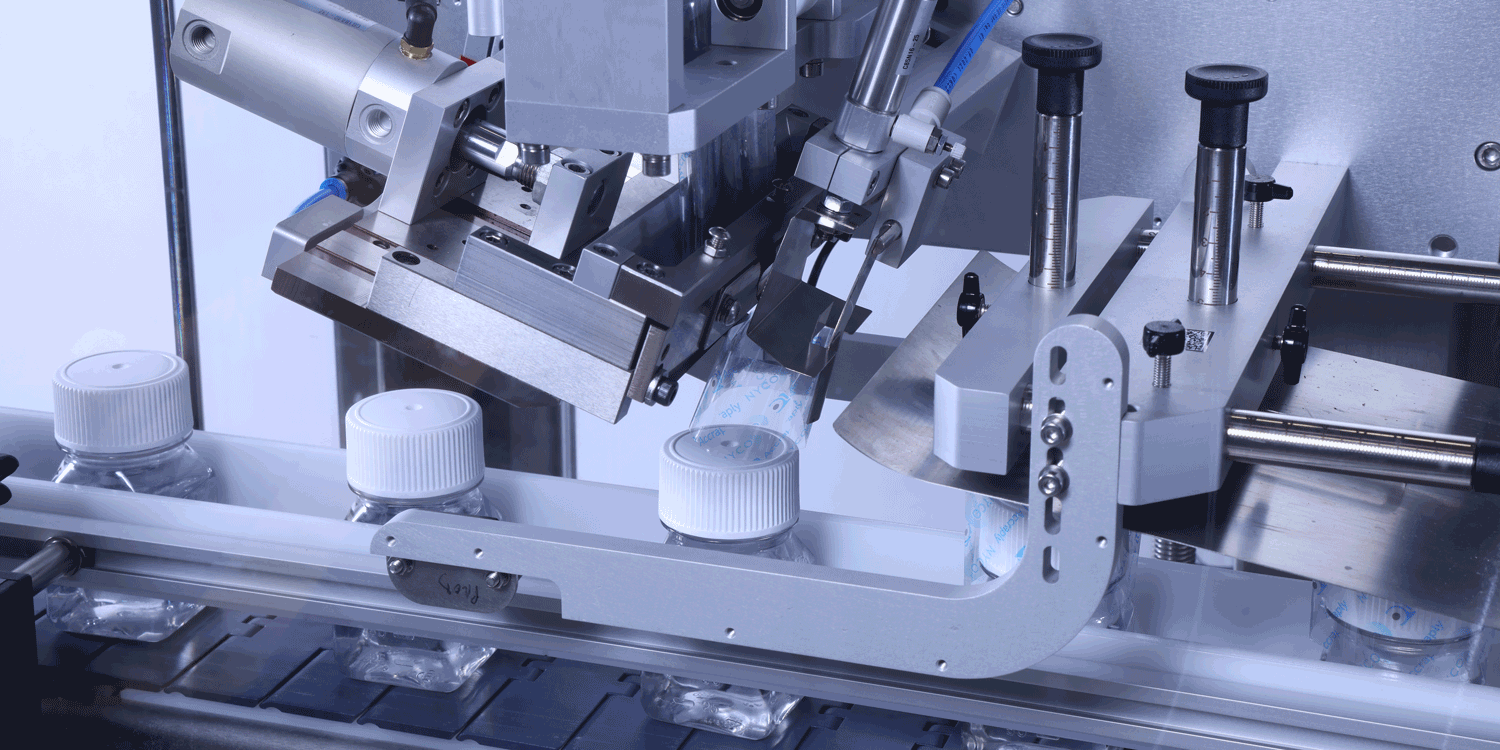
Sleevit's Direct Feed (DF) Series Systems provides a compact, flexible solution for shrink band applications. Servo-driven film handling helps ensure consistent placement, while the system's ability to convert between tamper bands and low-speed sleeve applications allows manufacturers to adapt as packaging requirements evolve.
Shrink Sleeves
What Are Shrink Sleeves?
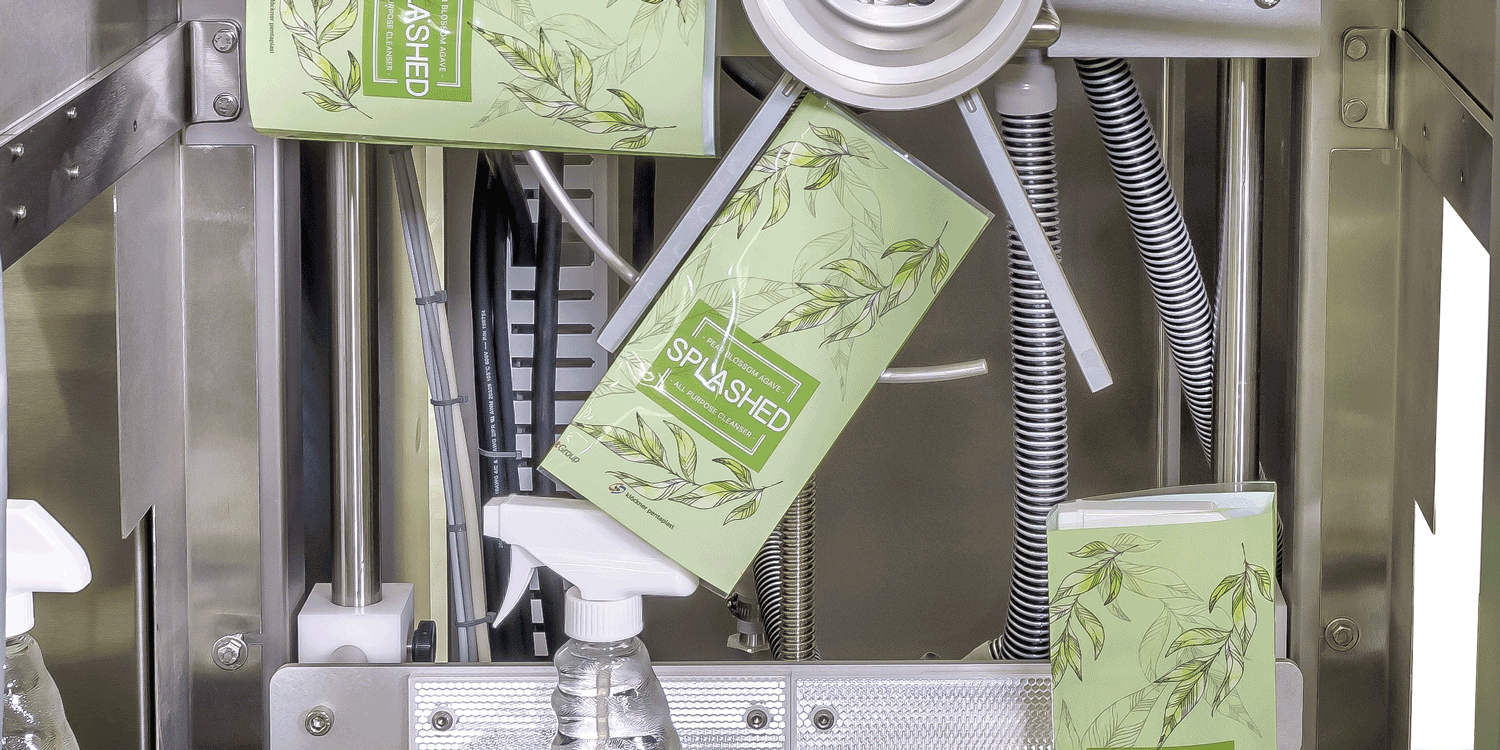
Unlike shrink bands, shrink sleeves cover part or all of the container body. Once heat is applied, the sleeve conforms tightly to the shape of the package, providing both decoration and tamper evidence.
Shrink sleeves can accommodate a wide range of container shapes, materials, and package sizes while offering nearly 360 degrees of branding space.
They can go over containers made from PVC, PET/PETG, OPS, PLA and even hybrid materials.
When Should You Use Shrink Sleeves?
Shrink sleeves are an excellent choice when:
- Packaging uniquely shaped containers
- Seeking both tamper evidence and strong shelf impact
- Creating a premium package appearance
- Bundling multiple containers together
Industries frequently using Shrink Sleeves include makers of personal care and household goods, pharmaceuticals and food and beverages.
When Are Shrink Sleeves Not the Best Choice?
Shrink sleeves may not be the best fit when:
- Tamper evidence is the only objective
- Material reduction is the primary goal
- Existing package decoration already meets branding needs
- Energy consumption associated with shrinking is a major consideration
Advantages
- Combines branding and tamper evidence
- Maximizes available graphics space
- Accommodates complex container shapes
- Creates strong shelf differentiation
- Enables rapid design updates across product lines
Tradeoffs
Shrink sleeve applications require heat shrinking equipment and precise control of sleeve placement. Sleeve orientation has historically been one of the industry's most significant challenges, particularly for highly designed packages where graphic alignment is critical.
What Solutions Does BW Packaging Offer?
Sleevit's Vertical Feed (VF) and Rotary Feed (RF) systems provide flexible solutions for both full-body sleeves and tamper-evident applications. Their modular architecture supports a broad range of container types while allowing manufacturers to scale capabilities as production requirements change.
Which Design Is Right for You?
Your packaging manufacturer can help guide your decision, based on your product, production speeds, and equipment and labeling you're currently using. Factors to consider include:
- Your existing equipment and how much space you have to expand your footprint
- Sustainability of the materials and process. With Shrink Bands and Sleeves, both the sleeve, and, depending on the container material, the bottle may be recyclable.
- The type of industries your products are in. If it’s one that experiences frequent change, either through innovation or branding needs, so that your graphics change frequently, Shrink Sleeves provide greater flexibility
- If you are using a pressure sensitive label, the Shrink Band is an easy way to add tamper evident protection without changing branding or graphics.
- Full Shrink Sleeve labels provide marketing flexibility to change the graphics with branding, flavors, and new container sizes.
- Many cosmetic, personal care, and pharmaceutical products are shipped in containers within a cardboard box. Wafer seals provide the tamper evident assurance in addition to sealing the carton.
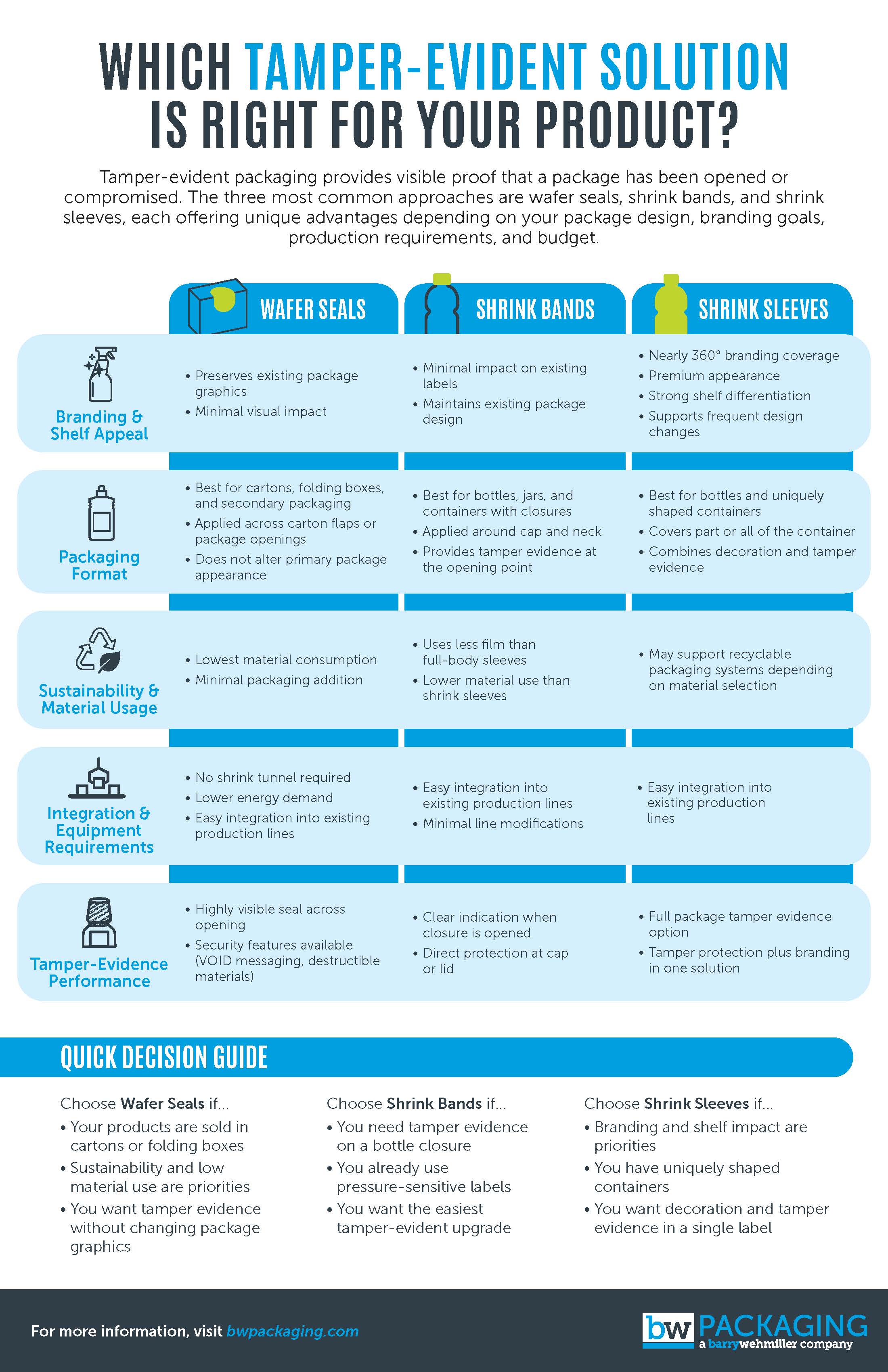
Download this infographic here.
What's Next
Although tamper-evident labels are a tried-and-true protection for manufacturers, that doesn't mean that innovation in this important area isn't happening. BW Packaging, for example, redesigned our labeling products a few years ago to make them easier to operate, and to ensure that the process was repeatable from the first product through the line. We do this by producing first-rate equipment with premium components and electronics that meet the most exacting requirements of even precision-driven industries such as pharmaceuticals. We build to our customers’ specifications, but with labeling and especially tamper-evident products, our basic requirement level is such a high standard that it meets most customers' needs without enhancement.
Unique to the marketplace is our Sleevit Rotary (RF) series of Shrink Sleeve applicators. This is a great machine for co-packers, since it provides fast changeovers and handles a variety of container shapes and materials, all in a compact footprint.
As BW Packaging continues innovating, Sleevit is developing a system that will revolutionalize the ability to accurately place sleeves on non-round containers. Thibaud Guittet, the Product Manager, Labeling, will be discussing this breakthrough at the AWA International Sleeve Label Conference & Exhibition in November in Illinois.
The protection provided by tamper-evident labels is critical to many industries. Partnering with a packaging manufacturer that continues to engineer accuracy, safety, and reliability into new products that enhance the efficiency of your overall operation is what has made BW Packaging labeling a choice globally across even the most exacting markets.